

Doing Everything Right and Still Feeling Off
Why effort doesn’t always translate into relief.
Hey, checking in, because the quiet stuff matters too. Today’s reflection: what happens when you follow the advice, show up, do the work, and still carry a sense that something inside you has not settled.
There is a particular kind of confusion that comes with effort. You sleep more. You hydrate. You move your body. You journal. You set boundaries. You name feelings out loud. You read the books people recommend. You do the exercises. You show up to therapy or coaching or conversations with honesty.
As a result, you expect a shift. Not perfection. Just relief. A sense that the work has landed.
And yet, some days, you wake up with the same heaviness. Or a quiet irritability. Or a low hum of unease that refuses to resolve. Nothing is obviously wrong. Nonetheless, nothing feels quite right.
This is often the moment when people turn on themselves.
The hidden belief beneath the effort
There is an unspoken story many of us absorb early. If you do the right things, you earn feeling better. Care becomes a kind of currency. Effort becomes proof of worthiness.
Therefore, when relief does not arrive, the mind looks for a reason. Maybe you missed a step. Maybe you did not try hard enough. Maybe you did it wrong.
This belief rarely arrives as cruelty. More often, it shows up as discipline. As self-improvement. As responsibility. However, it still carries a quiet threat. If well-being equals good behavior, then discomfort starts to feel like failure.
As a result, people double down. More structure. More tracking. More rules. Care tightens into control. What began as support slowly turns into surveillance of the self.
This is often when people whisper a familiar frustration; when self-care starts to feel like work.

Why checklists cannot hear you
Wellness culture loves clarity. Morning routines. Non-negotiables. Step-by-step plans. These tools offer comfort because they promise order. They suggest that the body and mind follow clear logic.
Regardless, human systems rarely operate that way. Emotions respond to context, history, and meaning, not just habits. A practice that helps one season can feel flat in another. A routine that once soothed can later feel empty.
When wellness turns into a checklist, something gets missed.
We stop asking how it feels and start asking whether it’s done.
Care starts to feel transactional.
Nonetheless, discomfort does not mean the practice failed. It may mean the need has changed.
Effort without ease
Many people reach this place after genuine growth. They learned language for feelings. They set limits where none existed before. They chose rest over constant output.
From the outside, this looks like progress. From the inside, there can still be tension. Calm exists, yet ease does not.
This is where another quiet pressure enters; when growth starts to feel like a performance.
You notice yourself narrating progress. You track insights. You wonder whether you respond the right way to stress. You ask whether you should feel more grateful, more regulated, more healed by now.
As a result, even awareness can feel heavy. You become both the person who feels and the one who monitors the feeling. Presence splits.
When relief does not arrive
Even when you follow every piece of advice, calm doesn’t always arrive. It does not come as a reward for good behavior. Somehow, peace seems to have its own timing.
The nervous system does not keep score. It responds to safety, not compliance. It reacts to meaning, not merit. Therefore, you can do everything right and still feel off.
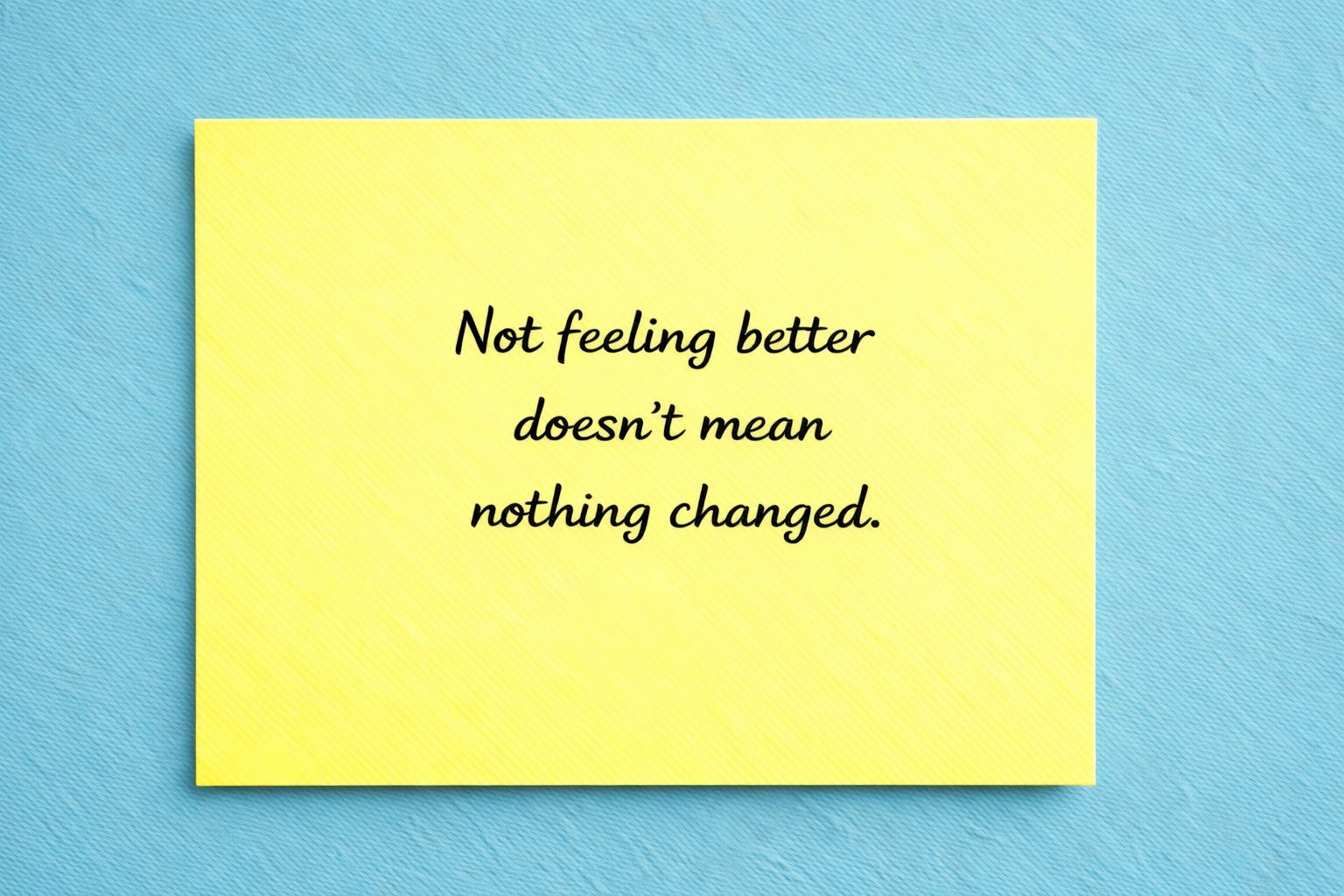
This does not mean the work was pointless. It means the work addressed one layer, while another still asks for care.
Some people hear this and worry it removes hope. In reality, it offers a different kind of hope. Relief does not depend on perfection. It depends on listening.
Discomfort as information
Discomfort often carries data. It points to needs that habits alone cannot meet. A sense of misalignment. A grief that has not found words. A desire that no longer fits your current structure.
Nonetheless, many people treat discomfort as an enemy. Something to fix or silence. As a result, they miss the message.
What if the unease does not ask for more effort, but for a different relationship with yourself. This is where a gentler truth can land. You can be healed without feeling healed.
Healing does not always arrive as lightness. Sometimes it arrives as clarity. Sometimes as honesty. Sometimes as the ability to sit with what exists without self-punishment.
The quiet harm of self-blame
When people assume effort should equal relief, they often carry unnecessary shame. They tell themselves they lack discipline. Or gratitude. Or resilience.
However, shame rarely produces safety. It produces tension. It keeps the system alert.
Ironically, this can block the very ease people seek. The body cannot settle while under evaluation. Therefore, removing blame becomes an act of care. Not because effort does not matter, but because effort alone cannot address every need.
What listening can look like
Listening does not require grand change. Often, it starts small. You might notice which practices feel supportive versus obligatory. You might sense when a boundary serves rest versus avoidance. You might allow a day without optimization.
Choice matters here. Choice without punishment. Choice without narrative. Nonetheless, this can feel unfamiliar. Many people learned to trust rules more than signals. Relearning trust takes time.
The role of patience
There is a rush within wellness spaces. Fix this. Heal that. Move on. However, some states ask for patience rather than action. They ask for space. For permission to exist without immediate improvement.
At first, it can feel backwards if you’re used to fixing things by trying more. Still, giving yourself space often lets relief arrive on its own.
Therefore, the question shifts. Not, what else should I do, but what might I need to stop forcing.
You are not behind
It bears repeating. Feeling off does not mean you failed. It does not mean you wasted time. It does not mean you misunderstood the assignment.
It means you are human within a complex system.
Many readers reach this point quietly. They keep showing up. They keep caring. They wonder why it still feels heavy.
If that is you, nothing about this moment disqualifies you from well-being. In fact, it may mark a deeper stage. One where listening matters more than effort.
Letting go of the scoreboard
There is relief in stepping away from comparison. From imagined timelines. From internal grades. Nonetheless, letting go does not mean giving up. It means changing the metric.
Progress can look like honesty. Like softness toward yourself. Like allowing rest without justification. These shifts rarely photograph well. They do not announce themselves. Yet they matter.
A quieter definition of care
Care does not always energize. Sometimes it steadies. Sometimes it simply prevents harm. Therefore, care can include staying with discomfort without turning it into a problem. It can include curiosity rather than correction.
Over time, this approach often creates space. Space for relief to arrive on its own terms. If you find yourself tired of doing everything right, consider this. Perhaps nothing is wrong with your effort. Perhaps your system asks for something that cannot live on a checklist.
You do not need to earn ease. You do not need to prove readiness.
For now, noticing is enough.

One thing that grounded me this week: finding an old receipt in a coat pocket from a bookstore that no longer exists.
One thing that ungrounded me: realizing the plant I had been “saving” for months was actually plastic.
Your turn. What is one small thing, grounding or ungrounding, that shifted your week.
If you are new here, step into the Joydify era, your soft landing for the quiet stuff that matters.
Thanks for subscribing to Joydify and sharing a quiet moment with us. Here’s to gentle support, one check-in at a time.