

The Kind of Loneliness That Shows Up in Company
When connection exists, but doesn’t quite land.
Hey, checking in, because the quiet stuff matters too. Today’s reflection is about loneliness that doesn’t announce itself. Sometimes it appears in company. It appears in full calendars, active group chats, familiar relationships. Nonetheless, something does not quite settle.
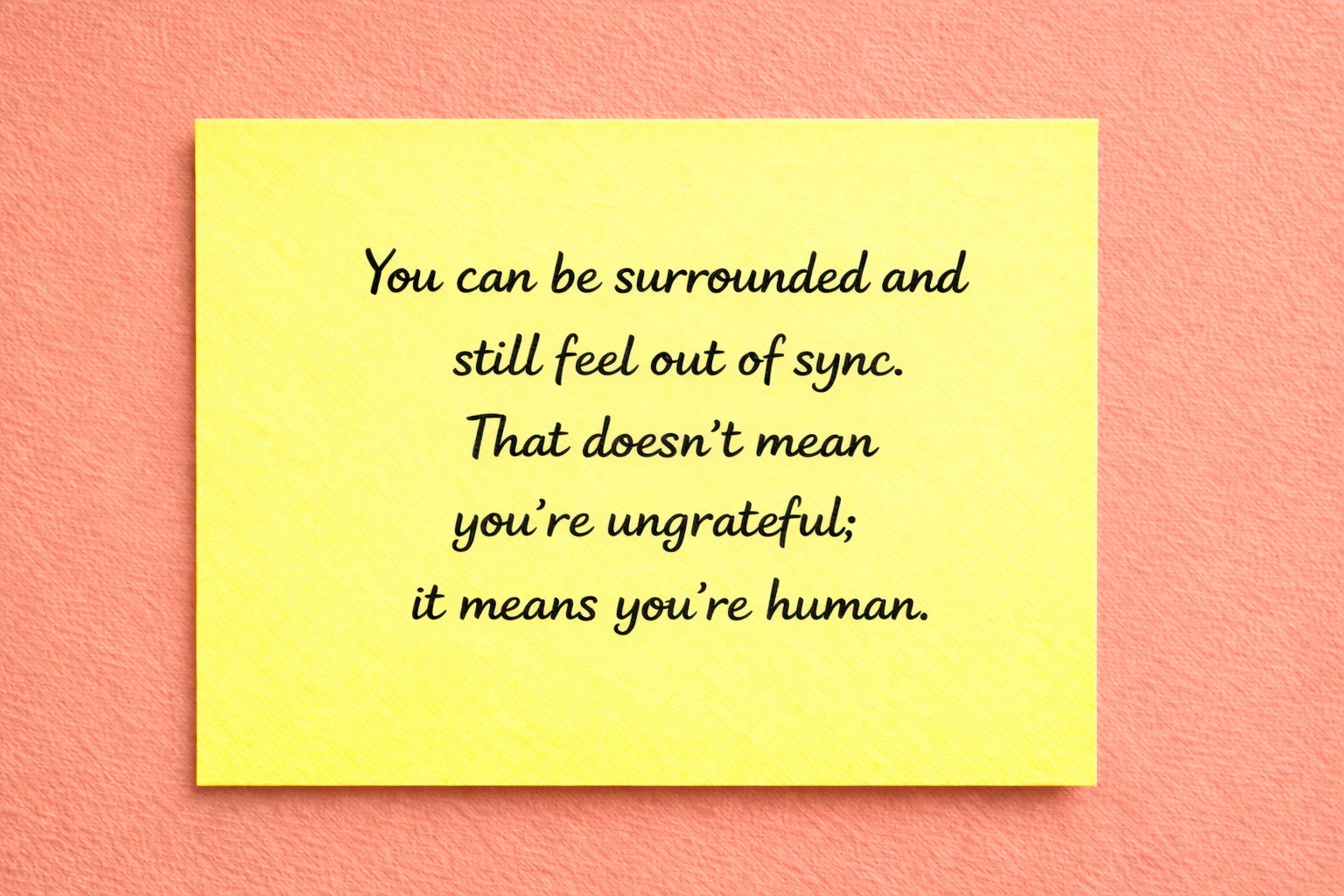
This is not the loneliness of being excluded. It is not about having no one. Instead, it is about emotional mismatch. You are included, but you do not feel met. You are present, but something essential stays untouched. As a result, the feeling can confuse more than it hurts.
Included, but not connected
A lot of people end up counting their way through loneliness. Friends. Plans. Messages that come in often enough. When those things seem fine, the feeling itself starts to feel questionable.
You might be talking with someone, answering, listening, staying engaged. Nothing is obviously wrong. Still, something doesn’t quite reach you. The conversation keeps moving, but you feel a little behind it, like it’s passing just out of reach.
This is the difference between inclusion and connection. Inclusion is about access. Connection is about resonance. You can have one without the other.
Many people live here quietly. They do not feel abandoned. They also do not feel nourished. Because there is no obvious absence, it becomes difficult to explain what is missing.

The guilt that follows
This kind of loneliness often brings guilt with it. You tell yourself you should be grateful. You have people. You have support. Others have less. As a result, the feeling gets pushed down. You minimize it. You question your own reactions. You wonder why you feel this way at all.
Guilt adds another layer of distance. Instead of noticing the loneliness, you judge it. Instead of listening to what it might be pointing toward, you silence it.
After a while, the feeling doesn’t ease. It just sits there, with more weight to it. Feeling lonely around people doesn’t have to mean anything is wrong with your gratitude. More often, it points to something in the connection that isn’t quite reaching you. Needs do not disappear just because circumstances look good on paper.
Social effort as a mask
There is a version of social skill that looks like strength but feels like hunger. You show up consistently. You check in. You support others. You remember details. You hold space. People may even describe you as connected. Nonetheless, you leave interactions feeling empty.
This is where social effort starts to act as a mask. You give energy outward. You stay engaged. You stay responsive. In doing so, your own emotional needs wait quietly.
Over time, this pattern can blur. You might forget what it feels like to be met rather than managed. You might confuse usefulness with closeness. When supporting others starts to feel like self-erasure, loneliness often hides inside that role.
Conversations that skim
Not all conversations invite depth. Some stay light by design. That is not a problem. The issue comes when most of your interactions live there.
You talk about schedules. Updates. Safe opinions. Shared frustrations that never move into vulnerability. Everything stays smooth. Therefore, nothing touches the core.
After a while, this creates a strange fatigue. You spoke. You listened. Yet you did not feel seen. This is when the tiny things that wear us down begin to accumulate. Not one big rupture. Just repeated moments of near-connection that never quite arrive.
Loneliness does not always come from absence. Sometimes it comes from repetition without depth.
Why naming it matters
Many people hesitate to name this experience because it feels dramatic. Nothing is technically wrong. Relationships function. Life moves forward.
Nonetheless, unnamed experiences tend to grow heavier. Without language, you turn the feeling inward. You assume it says something about you. Too sensitive. Too needy. Too much.
Naming this loneliness does not turn it into a problem to fix. It turns it into information. It says something about your inner world and what brings you alive.
Information allows choice. Silence does not.
When effort turns into strain
It is true that connection takes energy. Showing up always requires some effort. However, there is a difference between effort and strain.
Effort can feel worthwhile. It expands you. Strain contracts you.
When being around people starts to feel like work, it often means you are carrying more than the interaction itself. You manage tone. You manage reactions. You manage how much of yourself feels acceptable in the room.
Your body notices this even if your mind does not. Shoulders stay tight. Breath stays shallow. Relief arrives only after you leave.
This does not mean you dislike people. It means your system does not feel safe enough to rest while connected.
Loneliness as information
This quieter loneliness is not a verdict on your relationships or your character. It is feedback. It may be pointing toward a need for different kinds of conversations.
It might be pointing toward places where things don’t quite move both ways, or where there isn’t much room to be yourself. Or for moments that feel less careful. Or simply for some space to exist without adjusting so much.
Even without an answer, the feeling is worth noticing. Loneliness isn’t always about something missing. Sometimes it signals that something is misaligned. Listening does not require immediate change. It requires curiosity.
Small shifts, not big fixes
There is no dramatic solution here. No overhaul. No sudden boundary speech.
Change often begins with small moments. You share a preference instead of deferring. You let a pause exist without rushing to fill it. You choose one relationship where you soften slightly instead of staying polished.
Safety builds slowly. It builds through experiences where you show a little more of yourself and remain intact afterward. As a result, your system learns that connection does not always require vigilance.
The goal is not perfect closeness. The goal is reducing unnecessary strain.
Taking the feeling seriously
One of the most important shifts is allowing yourself to take this loneliness seriously. Not as an emergency. Not as a flaw. As a real emotional experience with meaning.
You are allowed to want connection that nourishes you. You are allowed to notice when something feels off even if you cannot explain it cleanly. Before withdrawal. Before resentment. Before numbness. This noticing matters.
Sometimes the most supportive thing you can do is admit, quietly, that something inside you wants more than surface contact.
That admission is not failure. It is honesty.
So…
Not everything needs fixing today. Not every pattern needs a plan.
For now, it is enough to notice that feeling disconnected in company has its own shape. It deserves language. It deserves care. And it deserves patience.
Loneliness, in this form, is not a sign that you are broken. It is a signal that your inner world is asking to be met more fully.
That request is reasonable.

One thing that grounded me this week: the weight of a hardcover book resting on my chest while reading on the floor.
One thing that ungrounded me: realizing my favorite mug had a small crack I somehow never noticed.
Your turn. What is one small thing, grounding or ungrounding, that shifted your week?
If you are new here, step into the Joydify era, your soft landing for the quiet stuff that matters.
Thanks for subscribing to Joydify and sharing a quiet moment with us. Here’s to gentle support, one check-in at a time.