

What Happens When “Okay” Starts to Feel Safer Than Hope?
When managing your feelings quietly replaces wanting more.
Hey, checking in, because the quiet stuff matters too.
Today’s reflection: the moment when “okay” becomes the goal, not because life feels good, but because it feels survivable.
At some point, often without announcement, something shifts. You stop aiming to feel joyful. You stop reaching for fulfillment. Instead, you aim for manageable. You aim for fine. You aim for not unraveling.
Nothing is obviously wrong. You still show up. You still function. You still laugh at the right moments. However, beneath that steadiness, something feels narrower than it used to. Hope begins to feel risky. Wanting more starts to feel like an unnecessary gamble. As a result, you lower the bar. You tell yourself this is maturity. You tell yourself this is peace.
Sometimes, it is not.
This is not numbness exactly. It is not despair. It is emotional settling. It is choosing “okay” because “okay” asks less of you. And for a while, that can feel like relief.

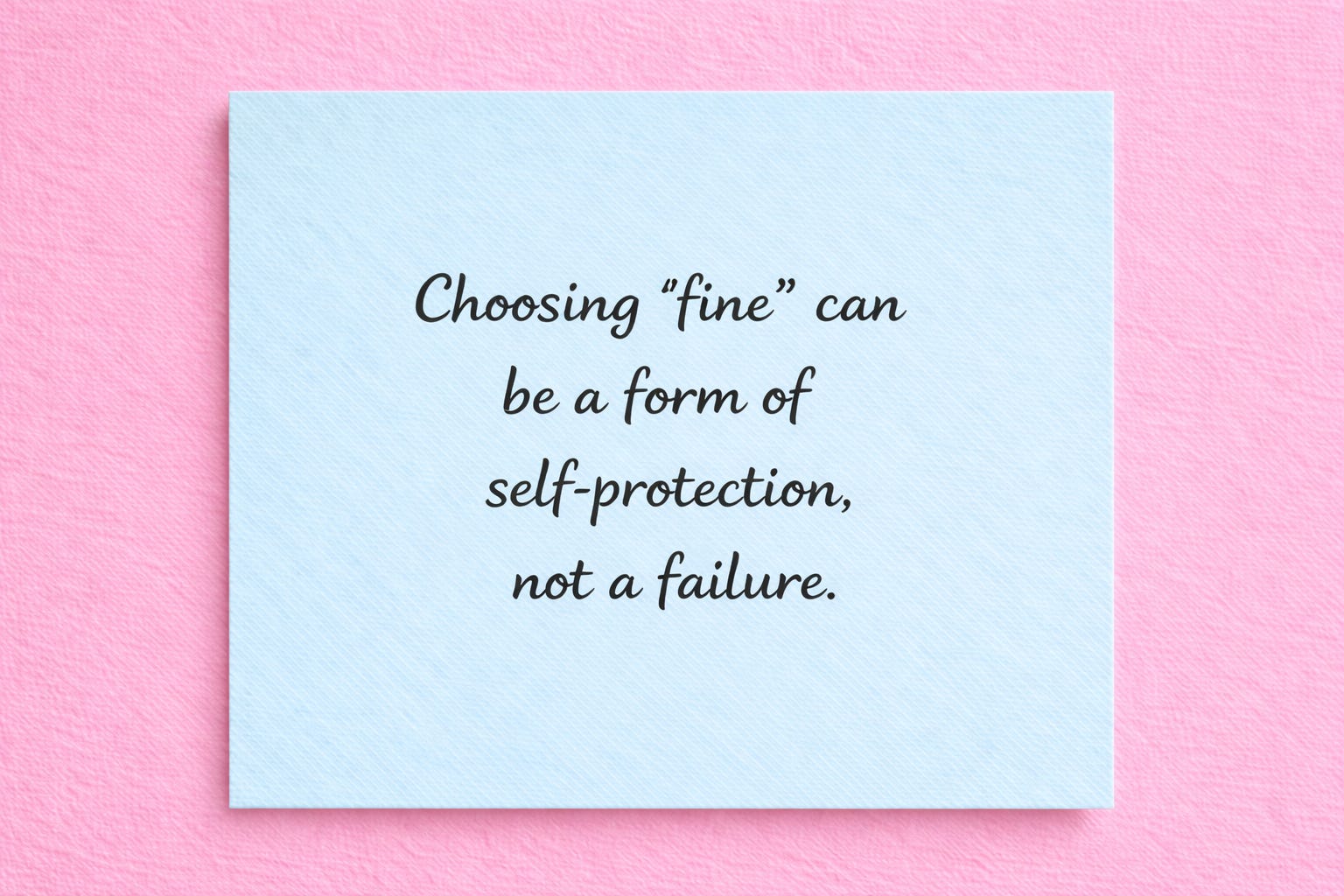
When “fine” starts to feel like safety
Over time, after things have felt heavy for a while, expectations tend to shift without much ceremony. You do not mark the moment. You simply stop reaching for certain feelings.
Over time, what you ask yourself shifts. Fulfillment matters less than whether something feels like it will tip you over. Life keeps going in the background. From the outside, everything looks acceptable.
In that context, “fine” becomes a refuge. It is predictable. It rarely surprises you. It does not demand vulnerability. Therefore, it feels safer than hope, which tends to expose you to outcomes you cannot control.
Often, this shift follows effort. You may have been doing everything right and still feeling off. You followed the guidance. You reflected. You adjusted. Over time, your system learned that effort did not guarantee relief. As a result, it learned to want less.
This is not failure. It is adaptation.
Peace versus emotional neutrality
At first glance, peace and emotional neutrality can look similar. Both appear calm. Both reduce volatility. However, the internal experience differs.
Peace lets you settle inside yourself. Neutrality can feel like a quieter version of life, with less color in it. The highs diminish. The lows soften. When calm starts to feel like suppression, it is often because neutrality has replaced peace.
You may notice that disappointment shows up less often. At the same time, delight becomes rare. Initially, this feels like progress. Fewer emotional swings mean fewer crashes. Nonetheless, over time, something feels absent.
You explain it as adulthood. You explain it as stability. That can feel true at times. Still, neutrality does not quite reach contentment, even when it seems calmer.
In reality, healing often prioritizes safety first. Safety can feel dull. Safety can feel emotionally narrow. Safety can feel like “okay.”
Why hoping can feel risky
Hope requires exposure. It asks you to imagine something better. It asks you to believe in an outcome you cannot secure. After enough unmet hopes, your system may decide that imagining less is safer.
This becomes especially true when disappointment feels personal. When wanting more has been met with loss, dismissal, or exhaustion, restraint begins to feel responsible. You do not stop hoping because you lack courage. You stop hoping because hope hurt.
Therefore, you make a reasonable trade. You exchange possibility for predictability. You exchange longing for control.
Many people never consciously choose this. Instead, it unfolds gradually. One day, you realize you no longer fantasize much. You plan. You manage. You maintain. Dreams feel abstract. Practicality feels grounding.
There is no failing here. It is simply a way your system learned to keep you steady.
The quiet grief of shrinking expectations
Even when this strategy works, grief can exist alongside it. Not loud grief. Quiet grief. The kind that hums without demanding language.
You may grieve the version of yourself who felt more easily moved. You may miss intensity, even when it was chaotic. Occasionally, a thought appears: is this it? Almost immediately, you correct it. Don’t be dramatic. You’re fine.
That correction matters. It keeps the grief from expanding. However, it also keeps it from being acknowledged.
Letting your expectations shrink can ease the pressure, but it can also take away small pleasures. The surprise in ordinary moments.. Loss of curiosity. Loss of reaching forward without calculating the emotional cost.
Naming that loss does not require undoing it. It simply brings honesty into the room.

When “healed” does not feel good
For some people, this stage follows growth. You did the work. You set boundaries. You stabilized your life. On paper, things improved.
Yet internally, something feels muted. This is where the idea that you can be healed without feeling healed begins to resonate. Function returns before aliveness. Regulation arrives before joy.
Naturally, confusion follows. Healing was supposed to feel expansive. Instead, it feels contained. As a result, you wonder if you missed a step. You notice that feeling grateful sometimes takes more effort than you expect.
In reality, healing often prioritizes safety first. Safety can feel dull. Safety can feel emotionally narrow. Safety can feel like “okay.”
That does not mean it is the final state. It only means it is a stage.
Managing instead of living
Gradually, emotions start to feel like logistics. You manage your mood. You regulate reactions. You keep yourself within acceptable ranges.
From the outside, this looks like maturity. In practice, it can also feel like distance. The difference is subtle.
Managing emotions preserves function. Living emotions creates texture. When management becomes the default, life can start to feel like maintenance rather than participation.
You are not numb. You are cautious. Cautious about intensity. Cautious about longing. Cautious about disrupting the balance you worked hard to achieve.
That caution deserves respect. It also deserves awareness.
Noticing without demanding change
This is where gentleness matters. Noticing that “fine” has become your goal is not a directive to want more. It is information.
Information about what you have been protecting yourself from. Information about how your system learned to stay safe. Information about the trade-offs you accepted quietly.
There is no urgency here. No call to optimize. No pressure to reopen hope prematurely. Awareness can exist without action.
Sometimes, noticing alone restores a sense of choice. Not the choice to change immediately, but the choice to be honest.
Honesty does not disrupt stability. It simply clarifies it.
When hope feels dangerous, that awareness itself is care. It says something shaped this. Something mattered. That deserves attention rather than judgment.
The relief and the limit of “okay”
“Okay” can save you. It can carry you through seasons when anything more would overwhelm your capacity. It can be the bridge between distress and stability.
At the same time, “okay” has limits. It minimizes pain. It also contains joy.
Often, this stage lasts longer than you realize. It is not about being stuck. Life simply carries on without urging change.
Disappointment stays rare. Longing stays quiet.
This is not a problem to solve. It is a state to understand.
Understanding creates space. Space allows movement when and if it feels safe.
Before the quiet shutdown
Long before burnout or despair, this stage often appears. Emotional settling. Reduced expectations. Careful living.
Noticing it early does not mean preventing it. It means respecting it. It means recognizing that your system chose “okay” for a reason.
When hope feels dangerous, that awareness itself is care. It says something shaped this. Something mattered. That deserves attention rather than judgment.
For now, “okay” can be enough. A refuge. A pause. A temporary home.
One thing that grounded me this week: a browser tab playing sound with no visible source.
One thing that ungrounded me: opening an app for one specific thing and forgetting why I was there within three seconds.
Your turn. What is one small thing, grounding or ungrounding, that shifted your week?
If you are new here, step into the Joydify era, your soft landing for the quiet stuff that matters.
Thanks for subscribing to Joydify and sharing a quiet moment with us. Here’s to gentle support, one check-in at a time.