

When Calm Starts to Feel Like Suppression
When peace turns into emotional editing instead of emotional regulation.
Hey, checking in, because the quiet stuff matters too. Today’s reflection: what happens when “staying calm” starts to mean shutting yourself down.
I used to think calm was the highest form of strength. No matter how chaotic things felt, I wanted to be steady. Unbothered. The one who stayed composed when everyone else fell apart. It felt mature, even admirable. It was soothing for a bit, until it wasn’t. After some time, that calm just sat on me, like I couldn’t let anything out.
At some point, I realized I wasn’t peaceful. I was muted.
We often treat calm as proof of growth. We celebrate those who can stay level-headed and unshaken. Yet no one tells you how easy it is for calm to turn into emotional absence. The world loves a person who stays composed, even if that composure is just control wearing a soft smile.
The difference between control and peace
It starts with small moments. You swallow a comment instead of correcting someone. You tell yourself it’s not worth bringing up. You breathe through anger until it disappears, at least on the surface. The more you do it, the more you start believing that calm means silence.
But peace without honesty feels hollow.
In a way, it reminds me that emotional hygiene shouldn’t start with a fire alarm. We often wait until something breaks before we tend to our emotions. We call it “staying calm,” but sometimes it’s really avoidance. We bury everything under stillness, hoping it passes.
People applaud that kind of calm. They say you’re easy to be around. They admire your patience. Yet they don’t see the cost. When you keep tucking your reactions away, after a while you stop feeling connected to who you are.
Eventually, calm turns into distance. You start watching your life instead of living it.

When peace becomes too quiet
There’s a point where calm stops being comforting and starts feeling like suppression. It happens slowly. You stop letting yourself sound frustrated. You tell people you’re fine, mostly because explaining feels like too much. Somewhere along the way, fine starts to lose its meaning.
This kind of calm begins to resemble emotional editing. You filter everything that doesn’t fit the version of yourself others prefer. It feels like maturity at first, but really, you’re just learning how to disappear a little.
It’s a similar pattern to when self-care starts to feel like work. The rituals that once restored you become maintenance for an image. You meditate, journal, light candles, and still feel disconnected. You’re managing calm instead of feeling it. True peace should feel like softness, not strategy.
The slow erosion of emotion
I used to believe holding back was something that happened only when it mattered most. Now I see it happens quietly, in so many ordinary ways. The polite nods. The laughter that hides discomfort. Those are the tiny things that wear us down.
They add up quietly. Every time you choose calm over truth, something inside you dims a little. And when you finally feel ready to express yourself, the words don’t come easily anymore.
You tell yourself calm is control. You think you are handling everything. But your body remembers in ways your mind tries to ignore. Your shoulders hold tension you do not notice. Your jaw tightens without warning. Your breath comes shallow and fast before you even realize it. The calm you show to the world begins to feel heavy. Like a coat you can’t take off.
At first, it protects you. Eventually, it isolates you.
The truth is, you can’t build peace by avoiding mess. Calm that excludes feeling eventually becomes exhaustion.
What happens before the breaking point
Before emotional burnout, there’s usually a quieter stage. You stop feeling motivated. You avoid conversations that require honesty. You scroll to escape instead of connect. You start thinking, “I just need to get through the week.” Those moments are the early signals before the emotional cliff, the struggles that rarely get noticed.
You can sense it when calm starts feeling too still. There’s no flow, no movement. Just emptiness with good posture. You think you’re managing emotions, but in reality, you’re standing perfectly still so nothing spills out.
The truth is, you can’t build peace by avoiding mess. Calm that excludes feeling eventually becomes exhaustion.
Learning to stay steady without shutting down
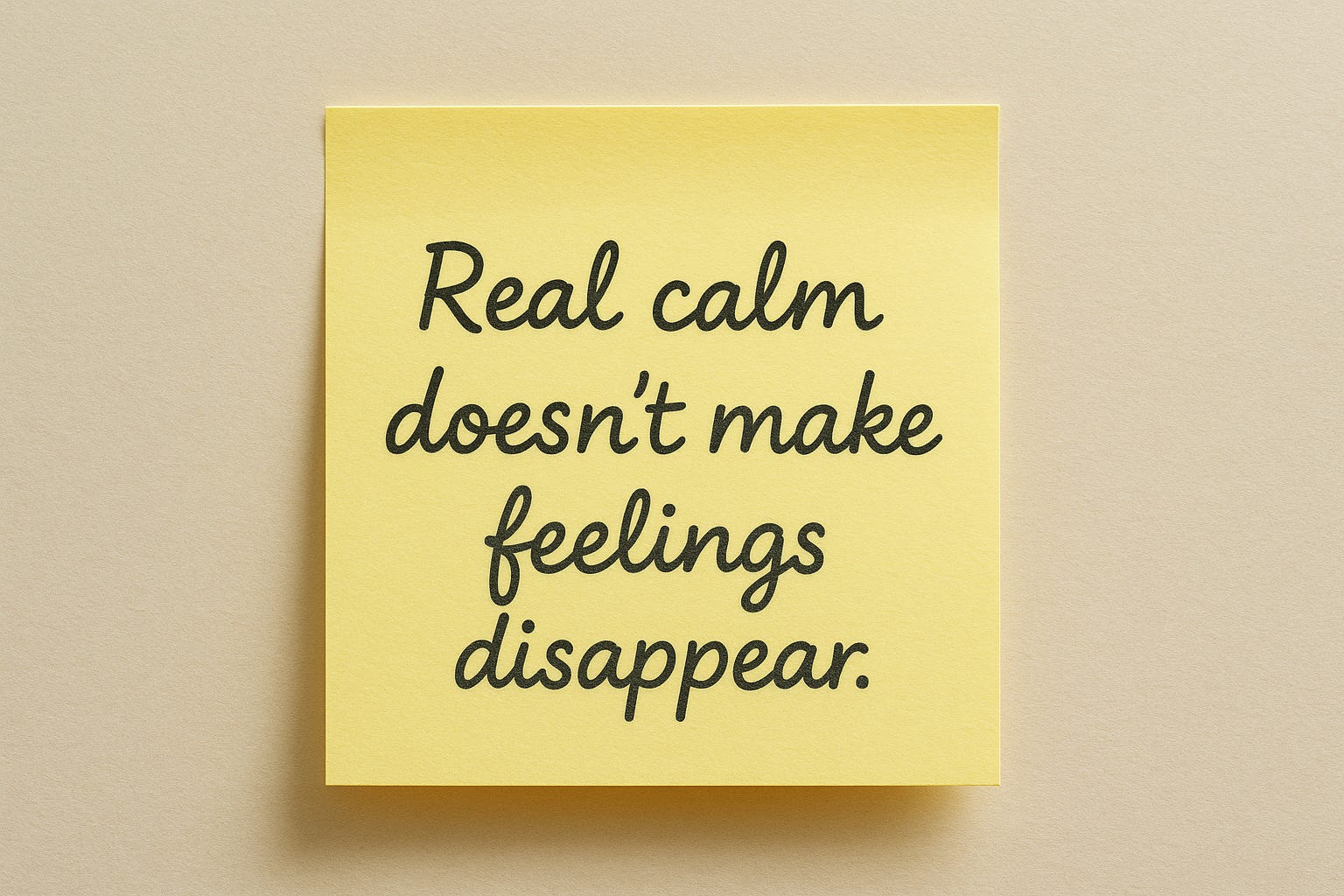
Real calm doesn’t make feelings disappear. It shows up when you can notice that you feel upset and still trust that you are okay. It’s not about telling yourself you’re fine. Or pretending that everything is okay. Steadiness comes from noticing what’s really there, even the messy stuff you’ve been holding inside.
It also means accepting that you can be peaceful and still feel pain. You don’t have to bounce back immediately every time something hurts. Slowness can be a form of calm too. Taking time to process is not failure. It’s honesty.
It does not come easily. The first few times you try to speak up, your voice catches. You pause. You fumble. You wonder if anyone will even get it. Or if your feelings are too much. At first, saying what you feel feels off. Feels like it doesn’t belong. Feels weird. Sometimes it scares you. Sometimes it makes your chest tighten. After a while, it eases. Just a little. Feels like something you might actually hold without it breaking you. Like it is yours. Eventually, staying steady while feeling everything becomes normal.
Calm isn’t about control. It’s about safety.
Small ways to practice honest calm
You try to stay calm. Not sure if it’s working. Maybe you just want to shrink back, disappear for a bit. Chest tight. Breath short. You notice how heavy it feels to sit with yourself. Strange. A little scary. And maybe that’s okay. Maybe it’s allowed.
You start paying attention without thinking you have to fix anything. Shoulders tense? Chest aching? That’s just your body talking. Calm doesn’t have to erase feelings. It can hold sadness, confusion, even anger.
It isn’t about stopping yourself from reacting. It’s about learning not to fear what comes up. You notice your thoughts, your hands, your chest. And somehow, just noticing feels like a little more connection to yourself, even when everything feels messy.
The real shape of calm
Eventually, you start to see that calm is not the absence of emotion. It’s the presence of safety. You can hold sadness and still feel grounded. You can express frustration without losing control.
Because you can be healed without feeling healed. Peace doesn’t erase emotion; it helps you carry it. That’s the kind of calm that feels alive instead of empty.
And once you experience that kind of steadiness, the old version of calm — tight, careful, quiet — no longer fits. You stop mistaking silence for strength. You stop equating peace with perfection.
One thing that grounded me. I found a little mom and pop coffee shop. They made a latte. Really good. Better than I expected. Felt… nice, in a quiet way.
One thing that ungrounded me. Spilled that same coffee a few minutes later. Pretended it didn’t bother me. Spoiler: it did.
Your turn: what’s one small choice, grounding or ungrounding, that shifted your week?
If you’re new here, welcome to Joydify, your soft landing for the quiet stuff that matters.
Thanks for subscribing to Joydify and sharing a quiet moment with us. Here’s to gentle support, one check-in at a time.