

When Nothing Is Wrong, But Something Is Missing
Living a functional life while quietly sensing an absence you cannot quite name.
Hey, checking in, because the quiet stuff matters too.
Today’s reflection is about a feeling many people carry for a long time without quite naming. Life functions. Relationships hold. Nothing obvious is broken. And still, something feels absent.
It is strange how unremarkable this feeling can be.
Most days move along without friction. You wake up, check the basics, move through responsibilities. You answer messages. You make plans. You cancel some. People rely on you, and you usually come through. When someone asks how you’re doing, you say something that passes. It isn’t false. It just isn’t much.
Fine. Okay. Doing alright.
And yet, there is a low hum underneath it all. Not loud enough to interrupt your life. Just persistent enough to notice when things slow down.
This is usually where people stop themselves. Nothing is wrong, they think. So why dwell on it?
The discomfort of things going well
There is a particular discomfort that comes from stability without depth. You are not unhappy. You are not in crisis. Still, there is a faint sense that you are slightly removed from your own life.
You notice it when something good happens and the feeling does not linger. Or when a free evening arrives and instead of relief, there is restlessness. Or when someone asks what you want and your first instinct is to deflect.
This does not feel dramatic. And maybe that’s the tricky part.
Because it lacks intensity, it feels illegitimate. There is no clear story to attach to it. No event. No turning point. As a result, many people decide it does not deserve attention.
They keep going.

When “fine” becomes the emotional target
At some point, feeling “fine” becomes the goal. Not joy. Not connection. Just fine.
Fine is manageable. Fine feels adult. Fine suggests you are coping in the correct way.
Most people do not consciously choose this. It happens slowly. Expectations accumulate. Energy gets rationed. You learn where to place your effort. You learn what not to ask for.
Over time, fine starts to feel like success.
Still, fine can also feel thin. It keeps the day from falling apart, but somehow it doesn’t always keep you.
Contentment and feeling alive are not quite the same. You might be okay with how things are and still feel… distant, like you’re watching yourself a little from the sidelines. Contentment comes from having stability. Aliveness seems to come from something that responds back, something you can’t fully control.
Aliveness has edges. It shows up as interest, disagreement, desire, curiosity. It includes moments that surprise you, even slightly.
When aliveness fades, you tell yourself it’s just adulthood. Bills need paying. Emails pile up. Meetings happen. And somehow… it feels like more than it really is. Some days it just sits there quietly. Everything seems normal. But also a little flat. Energy drifts around, sneaky, unnoticed until it’s gone. That story sort of holds… most of the time, anyway.
Nonetheless, it does not fully explain the quiet flattening many people feel.
Days blur together. Preferences soften. You still enjoy things, but the enjoyment feels muted. It ends quickly. You move on.
You can be healed without feeling healed. Structure returns before connection does. Many people stop here.

The guilt of naming absence
One reason this feeling stays unnamed is guilt. You look at your life and see evidence that you should not complain. You have relationships. You have stability. You have things that once felt important to achieve.
So when absence shows up, it feels inappropriate.
You might think, other people have real problems. You might worry that naming this feeling makes you sound ungrateful. You might decide it is better not to look too closely.
This guilt is powerful. It convinces people to doubt themselves.
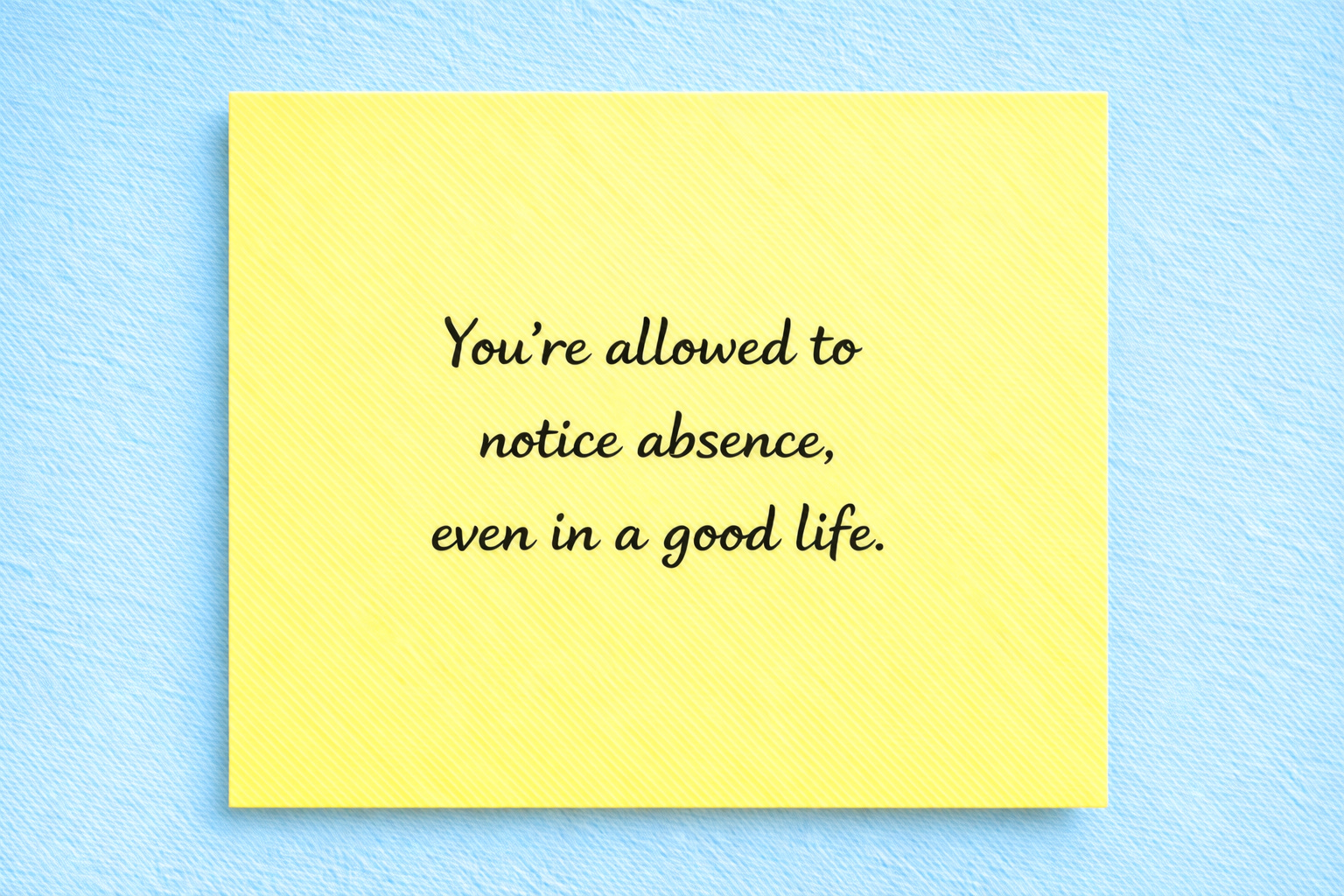
But noticing absence is not rejection. It is information.
The loneliness that hides inside connection
For some people, this feeling overlaps with the kind of loneliness that shows up in company. You are not isolated. You are socially engaged. You see people. You talk. You laugh at the right moments.
And still, something does not quite register.
Conversations stay on the surface longer than you expect. You share updates, not inner states. You feel known in fragments. No one is unkind. Nothing goes wrong.
Afterward, there is a quiet sense of being untouched.
This kind of loneliness confuses people because it does not respond to more interaction. Sometimes it deepens in busy rooms. As a result, many people assume they are misinterpreting it.
They let it go.
Minimizing as a learned response
Minimizing this feeling often starts as a practical choice. You stay busy. You focus on what needs doing. You assume it will resolve on its own.
For a while, that works.
Eventually, minimizing becomes automatic. You stop asking whether something feels meaningful. You stop checking whether you are engaged or just compliant. You measure your days by output and obligation.
The cost appears gradually. Joy dulls. Interest fades faster. Rest stops restoring you in the way it once did.
Nothing collapses. That is what makes it easy to ignore.
Gratitude used as pressure
Gratitude often enters the conversation here. Look at what you have. Focus on the positive. Remember how far you have come.
Gratitude can be grounding. It can also become a way to silence discomfort.
When gratitude turns into a requirement, it creates tension. It tells you certain emotions are unacceptable. It encourages you to override your internal signals.
Telling yourself you should be grateful does not resolve absence. It just teaches you to distrust your own experience.
Gratitude works best when it is voluntary. When it is allowed to coexist with honesty.
Why this feeling rarely gets care
This emotional state tends to fall through the cracks. Most models of emotional care activate around urgency. Panic. Loss. Burnout. Breakdown.
Subtle dissatisfaction does not qualify.
So people wait. They wait until numbness sets in. Until resentment builds. Until withdrawal becomes noticeable. By the time they seek support, the distance feels wider.
Early attention could have helped. But early attention felt unnecessary.
Noticing without forcing action
One fear keeps many people from naming this feeling. They worry that once they admit something feels missing, they will be expected to change everything.
Quit the job. End the relationship. Reinvent their life.
That fear keeps things quiet.
Noticing does not demand action. Awareness does not require disruption. You can name a feeling without assigning it a solution.
Sometimes it lingers while you do the dishes or scroll your phone, and you realize you can’t do much but notice it. That’s it. No arguing. No fixing. Not everything needs interpretation right away.

The slow cost of disconnection
When you stay disconnected from your internal experience, you start living from the outside in. You prioritize expectations. You follow scripts. You respond rather than initiate.
Eventually, simple questions feel harder than they should. What do I want right now? What feels nourishing? What feels like too much?
The answers are not gone. They are just quiet.
Reconnection rarely arrives as a breakthrough. It starts with small noticing. What lingers. What drains. What feels slightly more real than the rest.
Before absence hardens
Absence, when ignored, can harden. It can turn into numbness. Or low-grade resentment. Or a sense of moving through life on autopilot.
That is why early noticing matters.
Not because something is wrong. Because something is trying to be heard.
You do not need to fix your life. You do not need to label the feeling. You do not need a plan.
For now, noticing is enough.
Nothing is wrong. Something feels missing. And maybe… both of it can be true.
One thing that grounded me this week: a barista remembering my order without me asking.
One thing that ungrounded me: my phone autocorrecting a perfectly normal word into something deeply unhinged.
Your turn. What is one small thing, grounding or ungrounding, that shifted your week?
If you are new here, step into the Joydify era, your soft landing for the quiet stuff that matters.
Thanks for subscribing to Joydify and sharing a quiet moment with us. Here’s to gentle support, one check-in at a time.