

When Closure Doesn’t Come
Why some endings refuse to resolve.
Hey, checking in, because the quiet stuff matters too. Today’s reflection: when an ending refuses to explain itself, and your mind keeps circling the silence long after the moment has passed.
We tend to grow up with a pretty tidy picture of endings. In stories, things wrap up. Fights get resolved. Questions eventually land on answers. It is easy to internalize that pattern without noticing. We start to expect the same structure from our own emotional experiences. Something ends, we talk it through, we understand it, and then we put it down.
Real life does not follow that script very often.
Instead, a surprising number of endings arrive without ceremony. A message goes unanswered. A plan fades. A friendship thins until it barely resembles what it once was. No argument marks the shift. No official goodbye confirms it. As a result, you stand in a strange in between space where something clearly ended, yet nothing officially closed.
Your nervous system does not treat this as minor. It treats it as unfinished business.

The brain that keeps trying to solve it
Most brains resist loose ends. They look for patterns. They try to connect dots that may or may not belong together. So when an ending arrives without explanation, your mind does not rest. It leans in harder, searching for meaning in places that might never provide it.
You replay conversations. You examine tone. You construct timelines that might explain the silence. Some days this mental activity fades into the background. On other days it returns with surprising intensity. A small reminder can reopen the whole investigation.
From a distance, the determination can look faintly funny. Your mind keeps returning to the mystery long after the evidence dries up. Up close, however, the effort feels intense. Ambiguity generates tension, and your system interprets unanswered questions as a sign that the story is not safe to leave alone.
Therefore, an ending without closure can start to feel personal. You wonder what you missed. You assume there must be a hidden explanation that would make everything settle into place.
Ordinary endings that never announce themselves
Importantly, this experience rarely belongs to dramatic events. It lives inside everyday moments that most people barely discuss.
A conversation promises a follow up that never comes. A collaboration cools after early excitement. Someone who once shared daily details becomes distant without conflict. Opportunities disappear quietly, without rejection or confirmation.
These endings exist in a gray zone. Nothing dramatic happened. Still, something changed. As a result, your emotions struggle to find a clear category. There is no ritual for a conversation that never resumed. There is no social script for a friendship that dissolved without a fight.
You can notice a similar texture in other experiences. It appears when the win doesn’t feel how you thought it would. It echoes in the kind of loneliness that shows up in company, where presence does not quite translate into connection. Each situation carries a shared quality of incompleteness that resists easy naming.
Regardless, your system registers the shift, even if culture tells you it is too small to matter.
The culture that promises neat resolution
At the same time, modern culture speaks confidently about closure. Advice columns and self help language often suggest that every ending can reach resolution through the right conversation or insight. Sometimes that holds true. Direct communication can clarify certain situations.
However, that promise stretches further than reality allows.
Many endings involve factors beyond your reach. People carry private histories and limits that remain hidden. Even when an answer comes, it might not make sense. Pursuing closure can feel like holding your breath for no reason at all.
You wait for a message. You rehearse a future conversation that will supposedly settle everything. Meanwhile, life pauses around an invisible checkpoint. What happens when “okay” starts to feel safer than hope? Often, expectations shrink in order to avoid disappointment. Tension settles in quietly because nothing ever resolves.
The desire for clarity is human. Nevertheless, clarity cannot serve as a prerequisite for emotional peace.

Ambiguity as a quiet form of strength
That is also why tolerance for ambiguity counts for more than people usually say. Growing emotionally often looks like letting stories stay open and not blaming yourself for it.
This ability depends less on indifference and more on posture.
Instead of asking what explanation will fix this, you might ask how you want to carry the uncertainty. The shift sounds small. Still, it relocates the center of control from external answers to internal stance.
Acknowledge the ache. Let it sit. You can also hold that it mattered. Maybe you never fully understand it.
Your nervous system learns slowly. Every moment you let ambiguity sit instead of fixing it shows that it is survivable. The intensity fades.
The stories that fill the silence
Even so, the mind dislikes empty space. When closure does not arrive, interpretation rushes in. Frequently, that interpretation tilts toward self blame. You assume a mistake explains the disappearance. You search for personal flaws that would make the story coherent.
This reaction offers an illusion of control. If the ending happened because of you, then you can prevent a repeat. Unfortunately, many endings emerge from complex circumstances rather than single causes.
People drift for reasons unrelated to your worth. Priorities shift. Energy runs out. Some connections belong to a season instead of a lifetime. Accepting this reality does not erase sadness. However, it interrupts the habit of turning ambiguity into accusation.
A gentler narrative might sound simpler. Something changed, and the full story remains unknown. That absence of knowledge does not erase the value of what existed.
Choosing how to live with unfinished chapters
Since you cannot force explanation, the remaining question concerns space. How much room will this unfinished ending occupy inside you?
The answer does not require suppression. Ignored feelings rarely disappear. Instead, it invites acknowledgment. You recognize the incompleteness. You notice the disappointment or confusion. Then you allow the story to settle among other experiences rather than at the center of attention.
Some people create small personal rituals for ambiguous endings. A letter that never gets sent. A walk that marks transition. A quiet moment that honors the future you once expected. These gestures do not manufacture closure. They communicate respect for your own process.
Gradually, a subtle shift appears. The ending stays incomplete. Still, it stops demanding constant interpretation. It becomes one thread in a much larger fabric.
The steadiness of unfinished understanding
Eventually, a certain calm develops around stories that never resolved. It does not look dramatic. It looks like ordinary life continuing in the presence of unanswered questions.
Memories still surface. Certain reminders reopen the file for a moment. Nevertheless, the experience stops dominating your emotional landscape. You recognize closure as a gift when it arrives, not a requirement for healing.
Many endings will never offer that gift. They will remain partial or silent. Carrying them with care instead of resentment reflects a quiet form of wisdom.
For now, permission matters most. Permission to admit that unfinished endings linger. Permission to stop treating them as puzzles you failed to solve. Some stories refuse resolution because resolution was never part of their design.
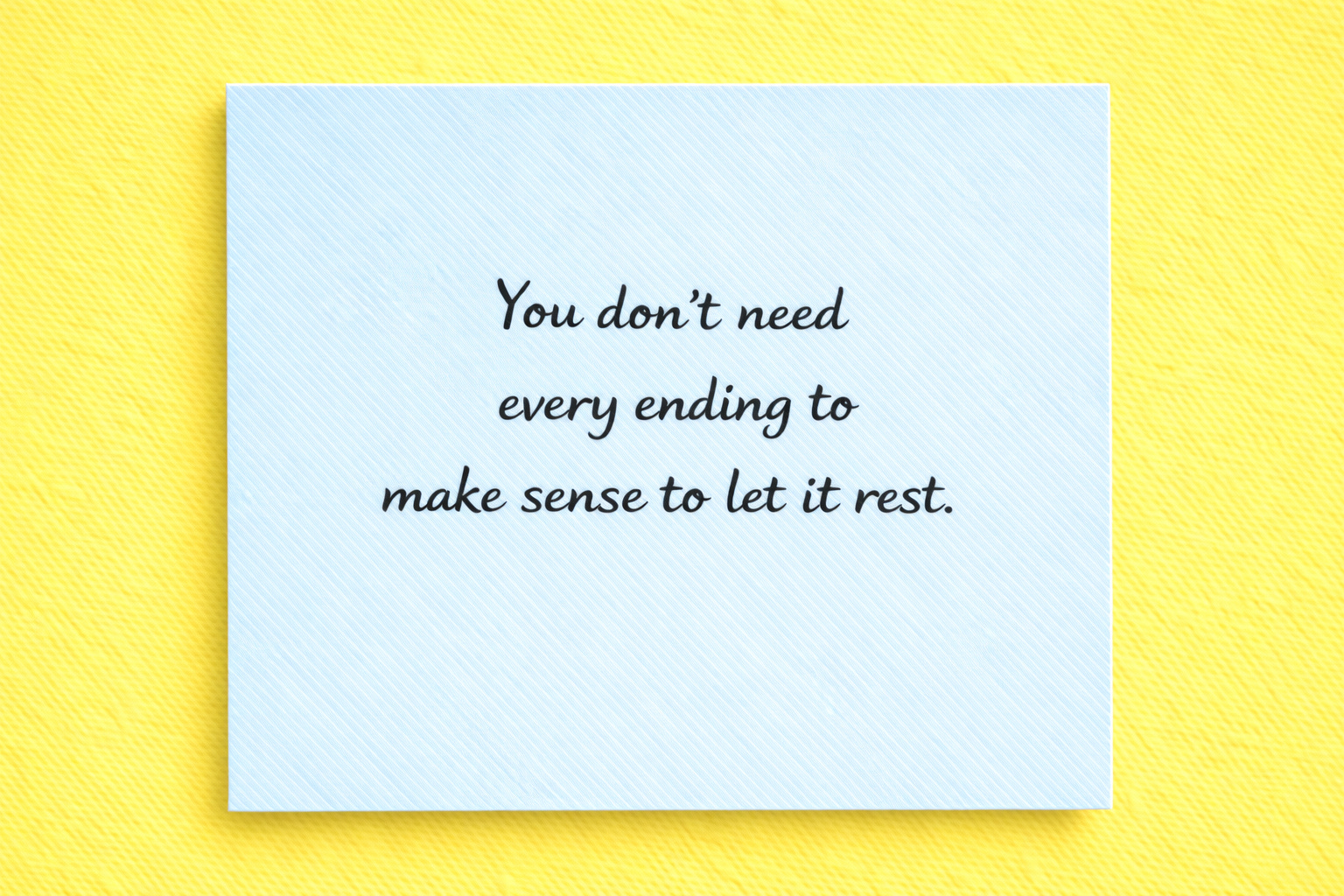
You do not need to close every chapter. Some pages will remain unwritten. You can still live fully.
One thing that grounded me this week: rewatching the Winter Olympics.
One thing that ungrounded me: I waved back at someone who was actually greeting the person behind me. Full commitment. No recovery.
Your turn. What is one small thing, grounding or ungrounding, that shifted your week?
If you are new here, step into the Joydify era, your soft landing for the quiet stuff that matters.
Thanks for subscribing to Joydify and sharing a quiet moment with us. Here’s to gentle support, one check-in at a time.